
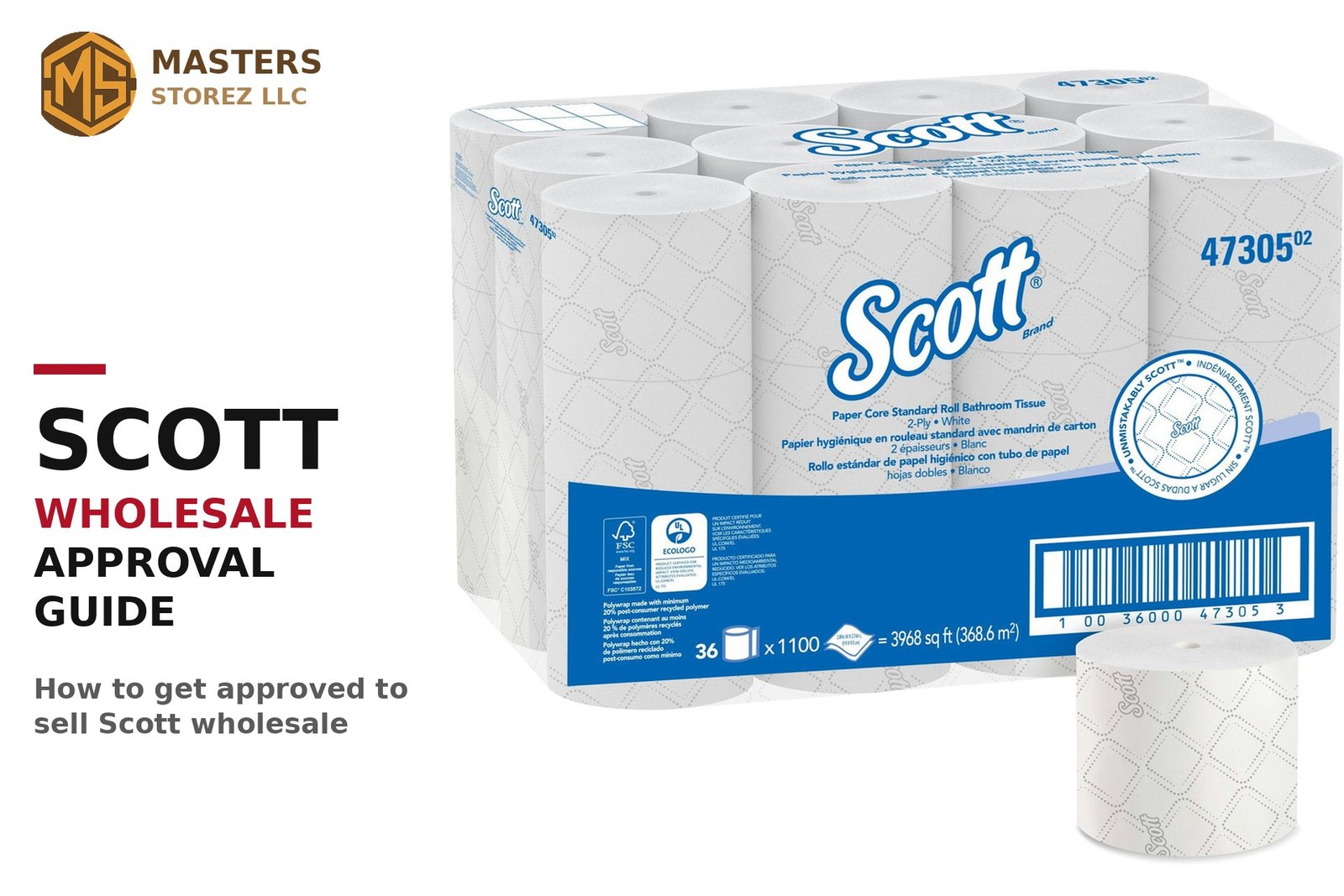
Scott is one of the oldest names in American household paper, and it occupies a useful middle ground for resellers: a trusted brand that shoppers recognize, priced below the premium leaders. Toilet paper and paper towels are products every household buys again and again, so a Scott line can give a small reseller steady repeat sales without the premium price tag that slows some shoppers down. This guide explains how scott wholesale approval works, what the brand realistically allows on each sales channel, and how to approach its owner, Kimberly-Clark, for a wholesale account.
Scott Wholesale Approval: Brand Name and Introduction
Scott is a household paper brand owned by Kimberly-Clark. Its roots go back to the Scott Paper Company, founded in Philadelphia in 1879 by the Scott brothers, and the company went on to pioneer the toilet paper roll in 1890. Kimberly-Clark acquired Scott Paper in 1995 and has sold the Scott brand ever since. The brand is positioned as a reliable, good-value choice rather than a luxury one, which suits resellers serving price-aware households. Wholesale supply runs through Kimberly-Clark Professional and its authorized distributors, so approval is a formal process.
Scott Available Categories
Scott covers the main household paper lines, and the range is wider than a single product. The best-known lines are Scott toilet paper, including Scott 1000, a long-lasting single-ply roll aimed at value buyers, and Scott ComfortPlus, a thicker option for shoppers who want more softness. The brand also sells Scott paper towels, Scott napkins and Scott facial tissue, giving a reseller a small family of paper goods under one name. Pack sizes run from small retail packs to large multi-roll club packs, and Kimberly-Clark Professional also supplies Scott in commercial and institutional formats, including bulk cases and jumbo rolls suited to offices, schools, restaurants and cleaning businesses. That commercial side matters for resellers who serve business customers as well as households. Scott does not extend into cleaning sprays or chemicals, so it will not fill a general cleaning shelf alone.
Scott Selling Permission: Which Platforms Allow the Brand
For Amazon, the position on Scott is unclear rather than settled. No brand-specific gating or intellectual-property complaint evidence has been found for Scott, and Kimberly-Clark has published no ban on Amazon resale of the brand. That is encouraging, but it is not a green light. Paper goods on Amazon are heavily dominated by Amazon itself as the seller on the leading listings, which squeezes the margin and the buy-box chances for a small third-party account. Before buying any Scott stock for Amazon, check the exact ASIN in Seller Central under Catalog and Add Products, and only proceed if your account is approved for that listing. For eBay and Walmart, no brand-specific restriction on Scott resale has been verified, but the same per-listing check applies: confirm the listing allows your account, and keep your distributor invoices ready in case the platform asks for proof that the goods are genuine. Scott also sells well through a reseller’s own store, a local shop or a wholesale counter, where no marketplace gate stands between the product and the customer. Treat Amazon as a possibility to verify, not a promise, and never buy stock for a channel you have not checked first.
Scott Wholesale Approval Method: How to Email the Brand for Approval
Wholesale approval for Scott runs through Kimberly-Clark Professional, the company’s commercial and distributor arm. Start at the official Kimberly-Clark Professional distributor resources page and use its contact route to open a wholesale enquiry. Before you write, gather the documents every brand owner asks for: your registered business name, your EIN, your state resale certificate, the type of store or sales channel you run, and a realistic estimate of your order volume. In the email, introduce your business briefly, name the Scott lines you want to carry, state how often you expect to reorder, and ask directly about distributor requirements — including minimum order quantities, which authorized distributors cover your area, and whether a letter of authorization is available for Amazon or any other marketplace you plan to sell on.
Scott Brand Reviews and History
Scott traces its history to 1879, when the Scott Paper Company was founded in Philadelphia, making it one of the oldest paper brands still on American shelves. The company introduced the perforated toilet paper roll in 1890, and by the early twentieth century its tissue was a household staple across the country. That depth of history is a genuine asset for a reseller: shoppers treat Scott as a dependable, familiar name, and the brand has survived more than a century of competition without losing its place in the aisle. Its reputation rests on value and reliability rather than luxury — Scott 1000 in particular is known as a long-lasting, economical roll — so it appeals to households that buy on quantity and price. What it does offer is consistency: a staple product with a loyal base of value-minded buyers, and a brand name that has been trusted in American homes for well over a hundred years.
How to Contact Scott for Wholesale Approval
The verified official contact route for Scott wholesale enquiries is the Kimberly-Clark Professional distributor resources page at https://www.kcprofessional.com/en-us/support/distributor-tools-resources. Use the contact route on that page to reach the Kimberly-Clark Professional team, and describe your business and your wholesale interest clearly. If the page directs you to an authorized distributor, follow that referral and open your account with the distributor, keeping your resale certificate and EIN ready. Our wholesale household products for resale guide explains how paper goods fit into a wider household assortment. If you would like help building a first household order around a brand like Scott, write to us at ceo@mastersstorezllc.com. You can also browse our homepage categories to see where paper goods sit among the lines we cover.